
Introduction to Conductivity Measurement
Conductivity is a key indicator of water quality, reflecting the concentration of electrolytes in a solution. This conductivity sensor module provides a cost-effective and straightforward solution for assessing water quality, making it perfect for hydroponics, aquaculture, and environmental water testing.
Product Specifications
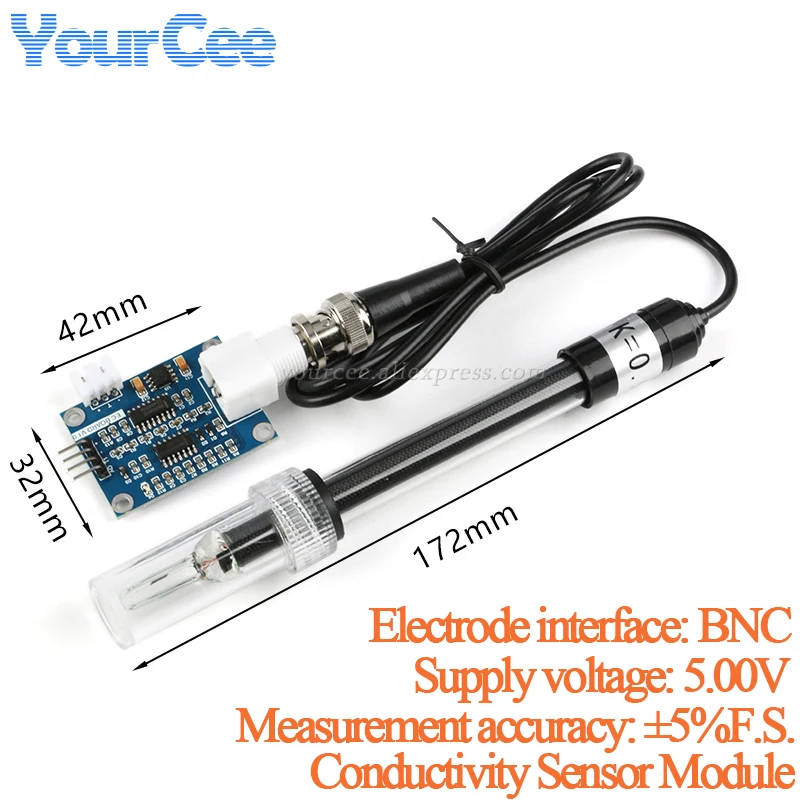
| Supply Voltage | 5.00V |
| Analog Signal Output Voltage | 0~3.4V |
| Measurement Accuracy | ±5% F.S. |
| Electrode Interface | BNC |
| Temperature Sensor Interface | XH 2.54 |
| Board Size | 42mm*32mm |
Conductivity Electrode Details
- Electrode Type: Laboratory-grade DJS-1 electrode
- Conductivity Cell Constant: 1.0
- Measurement Range: 0-20mS/cm
- Recommended Range: 1~15mS/cm
- Operating Temperature: 0-40℃
- Electrode Lifespan: >0.5 years
- Cable Length: 100cm
Pin Configuration
- VCC: Positive input voltage
- GND: Negative input voltage
- T1: Temperature sensor data output
- A0: Analog output port
Calibration and Usage Instructions
Calibration Procedure
For accurate measurements, perform a 2-point calibration using 1413uS/cm and 12.88mS/cm conductivity standards.
- Connect the sensor module and electrode.
- Calibrate the first point with 1413uS/cm standard solution.
- Calibrate the second point with 12.88mS/cm standard solution.
- Adjust the K value in the program accordingly.
- Compile and upload the modified program for accurate conductivity measurement.
Important Safety and Maintenance Notes
- Ensure the power supply is as close to +5.00V as possible for optimal accuracy.
- Use a temperature sensor for automatic temperature compensation to maintain measurement accuracy.
- Clean the conductivity electrode before each use to prevent contamination.
- Regularly calibrate the electrode, ideally monthly or weekly with frequent use.

Reviews
There are no reviews yet.